Showing posts with label housing. Show all posts

Friday, 11 March 2016

What’s mine is yours…

The rain returned eventually, with the 
sweet sound of it pouring into my tank. (H.Schulz)
A constant struggle for me when living in the village is the different cultural expectations of ownership and stewardship. What belongs to me and what belongs to the group? What is to be used now and what is to be saved for later?

I have a wonderful neighbour and village brother who built my house, looks after it while I am away and is one of our translators. He recently named his newborn daughter after me. I am sure that I have some sort of responsibilities for my namesake, but have no idea what they might be. He himself is a generous person who often has other people living with him in his small house and who is often doing things for other people. It is this particular relationship, with its web of obligations that is the hardest for me to navigate.

What makes it even harder is that it is often the small things that leave me in a crisis, such as an umbrella or a bottle of water.

My umbrella was left in my storeroom when I went away. It was about the only thing not packed in a box because it was too long. When I returned, it was the only thing that had gone walkabout. It had been borrowed to give shade to my namesake while they went to fish camp. When they returned, I saw the umbrella in use, but it didn’t return to me. A week later, when I was walking somewhere in the middle of the day and needed it for shade, I asked about it. It was brought out of the house, broken and barely held together with string. It gave me the shade I needed, but it is useless as shelter from tropical downpours.


Why was I so upset about an umbrella? It was that my trust of things left in storage had been broken, that something I needed was not there when I needed it. My neighbour though, saw it as an appropriate use of an item doing nothing to meet a need for my namesake. My tension is that I can understand his reasoning, but still wish it had been left alone and was in one piece when I returned.
Another day I found myself annoyed at a request for a few litres of drinking water, and even more annoyed at myself for being annoyed.

At the time it was dry season. As this was first time in the village in January, it was hard to tell if it is a drier than usual dry season, but it seemed to be that way. Each morning and each afternoon there was a parade of people going along the path by my house to get drinking water from a bush well. The round trip seems to take them about 45 minutes. Meanwhile, my house has two 1000L rainwater tanks.

Before I came to the village, my neighbour had called asking for permission to clean out one of my tanks. We did not communicate clearly, and I thought that rain was falling more often to refill the tanks, so I said yes, as long as you leave me at least half a tank (500L). When I got to the village I found out that there has been little rain, so the tank was not refilling, but that everyone had very much enjoyed getting a container of water from my tank when it was cleaned, as well as from half of the second tank. I was left the half a tank as requested. This probably saved the village one day of walking into the bush for drinking water, maybe two.

My umbrella two years ago when it was new. (D.Petterson)
When I returned, my neighbour turned up asking for drinking water in bottles, and I was annoyed. Why?! I did not make the rain fall, I just caught it. I did not earn it, yet I was reluctant to share it. Part of it was knowing that half a tank will not go far if I’m providing water for a house of six or more people next door. Part of it was knowing that if my water runs out, someone else will be the one walking into the bush to get water for me. Part of it was just cultural annoyance that ‘my’ water should be assumed to be ‘their’ water from a different cultural perspective. A lot of it was annoyance at myself for being a scrooge about water, an essential ingredient for life.

My first week in the village, I was cautious with my tank, but still used it for washing etc, thinking rain would continue to fall like it had the day after I arrived. By week two we’d had little rain, my tank was much lower and I switched to washing with well water and only using my tank for drinking. I still had occasional requests for water, which I would help with, but was not getting regular requests. This seemed like a good balance for me.

Still, the question of what is mine, what I am keeping for later, what is communal, and what I am sharing with others, is an ongoing struggle. Coming from somewhere very individualistic when it comes to possessions, I am having many of my assumptions challenged, which is a good but difficult process.

Friday, 29 January 2016

Home Alone

Now that I have my own house in the village, life has changed dramatically. Before my only space was my room and my only quiet time was my siesta. Now I have lots of quiet in every day. This has its own ups and downs.

 Hanging out in the kitchen (D.Petterson)
Having more space to myself has made a huge difference to my energy levels. Before I was in a busy and noisy house. The people were lovely and I’m very thankful for the time spent building those relationships, but I felt like I was surviving each day and then crashing into bed. Now I need to be deliberate in going out to spend time with people. Often I end up back with the family I previously lived with, sitting in the kitchen and hanging out with the women as before. The difference is that when I leave, I return to a place of quiet.

Having more energy because I have more space allows me to focus more on language learning. Previously I was immersed in language all day long, but was often too tired to concentrate well. Now I have my blocks of language immersion, then time at home to go over my notes, listen to my recordings and slow language down to a speed that I can comprehend. Ideally, this means I am building up my language skills for the next round of immersion. Rather than drinking from the fire hose of language learning all day, I have breaks to try and sip at it instead. Being disciplined about continuing my learning at home is a challenge, as it is very easy for me to read a book in my own language rather than continue working at a new language.

Having my own kitchen gives me more control over my diet and the timing of my meals. Small things like familiar food and a variation from fish and sago make a big difference to my ability to focus on other things. The familiarity of food I cook and being able to eat earlier in the evening allow me to invest my energy better in the multitude of other unfamiliar things going on around me.

 Hanging out with the women (H.Schulz)
Returning from my first language learning trip, when I had lived with a family, I was exhausted. I hid in my house for two weeks as a hermit and only came out and socialised after that because I had to. Returning from my second language learning trip, when I was living on my own, I was out and enjoying the company of friends within a few days of my return. The biggest factor in the difference in my social energy levels on my return was having my own house. Having the space gave me the energy to better invest in relationships and language while in the village, even though it does take more discipline.

Friday, 13 November 2015

Lifestyle Gap

My village house.
My house is the fanciest house in the village.

I have indoor plumbing (one tap to put a bucket under), indoor toilets (composting), power (2x 95w solar panels) and I’m cooking with gas. Each of these items on its own makes my house fancy. Together they make my house the best in town.

Compared to Australia though, I am roughing it. Bucket showers with brackish well water (at least until the drought is over), just a few 12v plug points, no phone or internet, no oven, no fridge, no furniture… people go camping with more comforts than I’ve got!
My neighbour’s house.
He plans to rebuild soon

Lifestyle gaps are a strange thing. By Australian standards, my village house is little more than established camping. By village standards, I’m living in swamp luxury.
Village kitchen, sitting on the floor
 and using a fire in the tropical heat.

A village toilet
Negotiating being the one with so much is a challenge. It teaches me to be thankful for what I do have rather than focussing on what I don’t. It teaches me to be thoughtful about what I own and what I consume, as I do not want my wealth to be a barrier to relationships. It teaches me to be generous, as I am too egalitarian to be comfortable in my castle while others wish for one of their own.

My indoor bathroom with
wash place and toilet
My real lifestyle gap with my PNG village is that I can leave. I can go away from my fancy village house to an even fancier house in the Highlands. I can then go away from that house to Australia and my Highlands house seems simple in comparison.


My biggest challenge with lifestyle gaps in the last year has not been returning to Australia with its comforts and riches, but the day the medical ship was in my area. Being aboard the big air-conditioned ship, sipping a coffee and looking at the village through the deck to deck windows felt like I was watching my own life on a documentary. I can cope with Australia being Australian, but when a piece of Aus floats into my PNG neighbourhood, I feel the clash distinctly. The ship does good work and I’m glad it visits, but it forced me to face the uncomfortable reality of my lifestyle gap in a way that I prefer to compartmentalise. 


Friday, 3 July 2015

A village house in pictures

Let’s go on a guided tour of my village house.

In February there was a block of land and an idea. 

On the empty land with Sampson, who is a literacy teacher, translator,
my neighbour, my  village brother and the one who was in charge
of building my house.
I didn’t expect there to be a house on that land when I returned in April, but it was well under way.


Over the next five weeks, it was finished!

There were two big working bees involved. The first was the biri party, when about 40 women from Ubuo (my village) and Goiravi (a 15 minute walk away) came to stitch thatch for the roof from nipa palm leaves or to cook food for the workers. About 30 men and boys turned up to finish the roof frame and attach the thatch.

Expert biri stitchers

Novice biri stitcher, but the centre of attention for giving it a try.
I completed three lengths of biri

The team doing framing and putting the biri up.
They’ve already completed the far side of the house.

When the decision was made to dedicate my house on the coming Sunday, my house was far from complete.

Thursday, when the dedication is to be on Sunday.
No end walls,no internal wall, holes in the floor,
an open patch in the roof…!
Thankfully the next working bee was on the Friday,  when a work team came from Kapuna hospital to install my toilets, wash place and rain water tanks. Due to technical difficulties, the tanks did not get done that day. The team arrived in the morning, offloaded their supplies and worked hard all day. Others from the community turned up and an amazing amount was achieved.

Cleaning up ready for the working bee to start
The Kapuna team turns up and offloads supplies…

…including the ark of the covenant?!
No, just a big, heavy box full of tools....
…including power tools, so they brought a generator too.
Later in the day, the end wall is finished,
the front stairs are in place and decorative
railings are being installed.
Inside, the Kapuna crew install
composting toilets and a wash place.
 A lot more work happened on the Saturday, and on Sunday we really were ready to dedicate the new house. The land owner was the one who gave me the key to the front door and said that he gave the land to the Kope translation project.

Dedicating the house was quite the ceremony…
… and of course was finished with a feast.

Inside my house I have three bedrooms (who of you will be first to visit?), a store room, a bathroom, a kitchen space and my long open living area. There is also the translation verandah, which is my attempt to have some sort of work/private divide in the village. We’ll see how that goes!

Finished house looking towards the front door.
The sawn timber is all off cuts from the local timber mill
Finished house looking from another angle.
The low bit is my translation veranda.
The window up higher is my kitchen window.
My bedroom, which is basically a mattress on the floor
under my mosquito net plus a small amount of hanging storage
Standing in the front door looking at the living
space on the left and translation veranda on the right
The space that will become my kitchen once benches are installed. I’m organising a gas bottle through the hospital, so shall be cooking with gas on my two burner stove. Once my rainwater tanks go in, outside this window, I will have a tap in the kitchen and one in the bathroom. These will be high enough to put a bucket under, not high enough for a sink or a shower, but that is still indoor plumbing!
My bathroom, and yes, I have been saying toilets in the plural.
 The twin toilets are part of a sanitation scheme being trialled by the hospital. Most Gulf toilets drop straight into the river, where the tide flushes them twice daily. This is the river people bathe in and eat the fish from.
 It is hard to dig a septic toilet on land, as the whole area is a swamp and the ground is saturated. This means that the tide comes in and out in holes in the ground as well as in the river. Even places on higher ground get flooded by the occasional king tide.
The idea of this system is that the barrels (recycled from an oil drilling company) hold the waste away from the water. The solids remain in the barrel and slowly compost. The liquids escape through a pipe in the bottom into a pit beneath. I will use one toilet at a time. Once the first toilet is full, I will leave it to compost while filling the second toilet. Once the second toilet is full, the first one should be done composting, and can be emptied onto the garden for the process to begin again.
At the moment this is still in the trial stage, but the hospital is hoping to get funding to widen the scheme to villages across the region.
Looking from my kitchen along the living area. Sampson is installing the door on the storeroom. You can just see my mossie net in the bedroom on the right. The camp chair on the floor is my one piece of furniture. As it is light and portable I take it almost everywhere with me. A little bit of cushioning and back support make a huge difference when sitting for hours on the floor of a church or in a dugout canoe.
Looking back at the front door along the translation verandah.
Through the house windows is the living area.

Some of the beautifully woven panels of wall inside my house.

Friday, 22 May 2015

Year of the House


Having grown up in church-owned housing and rented my way through a number of houses as an adult, the great Aussie dream of home ownership has always been just that, a dream. This year though, that has changed.

Recently I was given a house in Ukarumpa.
My new Ukarumpa home.

This is our ‘company town’ in the Highlands where I am based when not living in a village situation. It is my base of professional support, personal friendships and ex-pat belonging. It is a town with a complex identity that means different things to different people, but for me it is one of my PNG homes. It is also now a place where I own a home.

Robyn (Aussie) came to PNG in 1987 and Lisbeth (Swede) arrived in 1986. Together they worked with the Ramoaaina people of the Duke of York Island near Rabaul, dedicating the Ramoaaina New Testament in 2007. They continue to work in that region, supporting the Ramoaaina Old Testament translation as well as the Label, Kandas and Fanamaket New Testament translation teams from nearby New Ireland Province.

Previously, they too were Ukarumpa based, coming and going to the Islands. These days they are Kokopo based and no longer need their Ukarumpa house. Some people sell their home, but they decided to give theirs away. It is a cosy little home, with three bedrooms, office, living room, kitchen and shed. At the moment I live here alone, but may end up sharing with another single woman either long or short term.

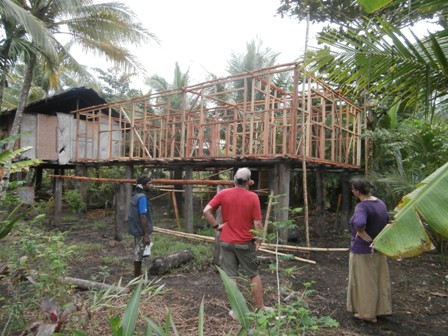
At the same time as moving into my Ukarumpa home, I have been getting ready to go to the village, where I am in the process of building a house. Land has been set aside and posts and bearers have already been installed. I am bringing a solar power system with me, and water tanks and some tin roofing for water catchment are on order. Nails, hinges and a saw are among the items I’m providing to assist in the building effort.

An Ubuo house (not mine) under construction (D.Petterson)
So it is that this year will probably end up with me having two homes to call my own! While I have been given one house and am buying nails to build another, my sister has gone through a mountain of paperwork and stress to gain a mortgage and purchase a home in Australia. The contrast in home acquisition is stark, yet so is the nature of our houses.

My Ukarumpa home is on land that is part of a 99 year lease to an organisation I am a member of. My village house is on land that I have no title to. Both houses are in a country where I currently have a five year visa. I expect to be here long term and renew my visa many times, which is why I am investing myself and my resources, but many things could easily change. Still, I am excited at these developments that continue to make this country more and more ‘home’.